


Why is the dwarf planet beyond Pluto trending?
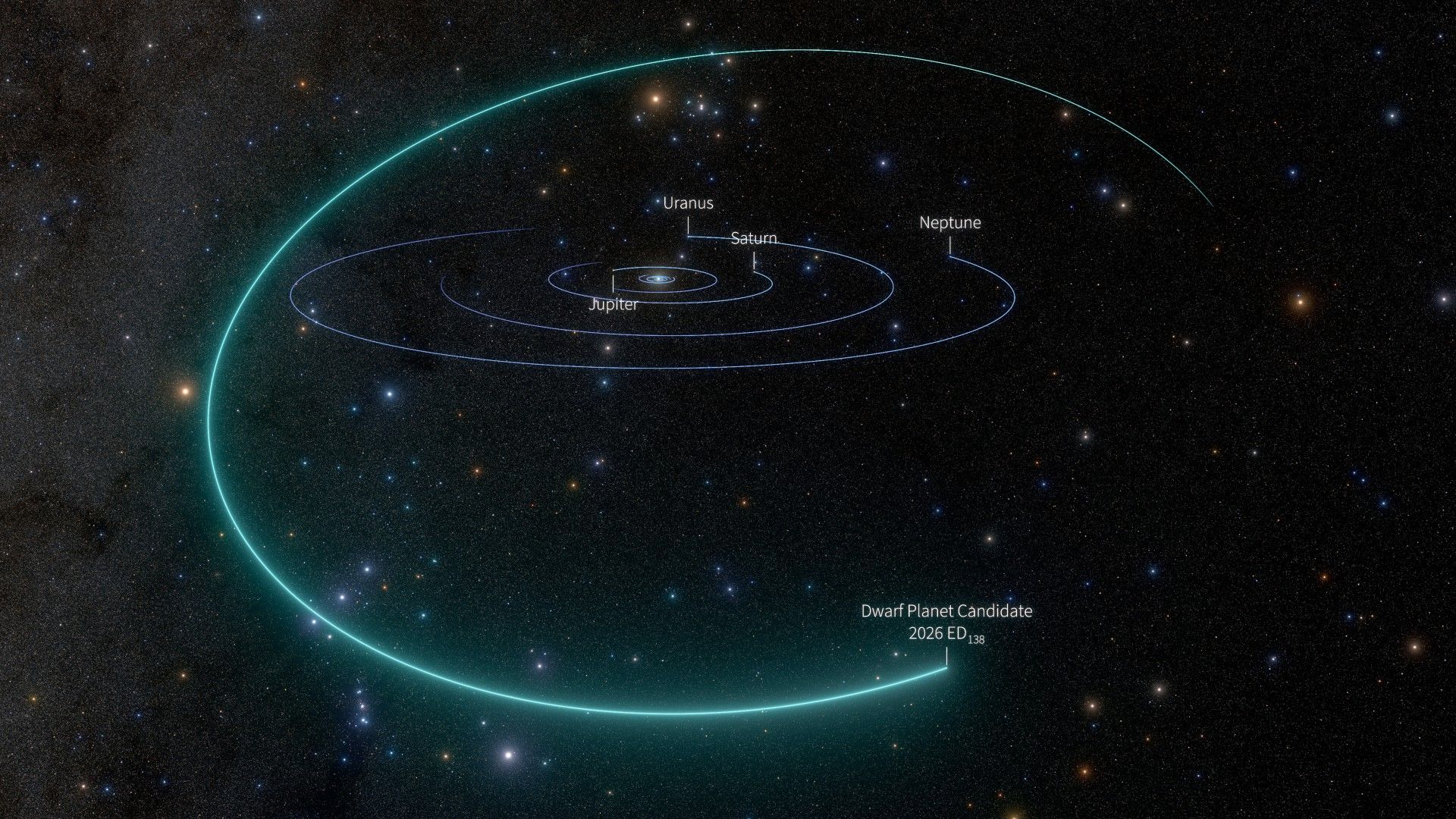
The object, temporarily named 2026 ED138, was spotted by the Vera C. Rubin Observatory and may be the largest and brightest in its region. It is now under consideration for official recognition as a dwarf planet.

What happened
- Earlier
The Vera C. Rubin Observatory began its mission in June 2026 to explore the cosmos [1].
- 4 Mar, 2026
The observatory started observing the Milky Way and beyond, collecting data on the southern night sky [1].
- 13 Oct, 2026
Astronomer Matthew Holman discovered the object 2026 ED138 while running data through a search code [2].
- 27 Oct, 2026
The discovery of 2026 ED138 was announced, and it is now under consideration for official recognition as a dwarf planet [1].
What you need to know
The object is estimated to be between 600 and 1500 kilometers wide.
It is classified as a trans-Neptunian object.
The Vera C. Rubin Observatory is a 10-year mission to explore the cosmos.
Further observations are needed to confirm if the object is a dwarf planet.
Background
The Vera C. Rubin Observatory is a powerful telescope located in Chile, equipped with a large digital camera. It is part of a 10-year mission to observe the southern night sky and collect data on the cosmos. The observatory is named after astronomer Vera Rubin, known for her work on dark matter.
The object 2026 ED138 was discovered by astronomer Matthew Holman using data from the Vera C. Rubin Observatory. It is estimated to be between 600 and 1500 kilometers wide and is classified as a trans-Neptunian object.
If classified as a dwarf planet, 2026 ED138 would join five others officially recognized by the International Astronomical Union: Pluto, Ceres, Eris, Haumea, and Makemake.
Questions people ask
What is the Vera C. Rubin Observatory?
It is a powerful telescope located in Chile, part of a 10-year mission to observe the southern night sky and collect data on the cosmos.
What is the estimated size of the new object?
The object is estimated to be between 600 and 1500 kilometers wide.
What is a dwarf planet?
A dwarf planet is a celestial body that has enough mass for its own gravity to pull it into a round shape, but not enough to clear its orbital neighborhood of debris.
Where this came from
Found through Google Trends and drafted with AI from at least two cited sources. Published automatically after passing our automated checks for sources, wording and safety. It may not have been reviewed by a person yet. Report a correction.